JHS Pedals - OIl Can Delay
The JHS Pedals 3 Series is a collection of pedals designed to give you affordability and simplicity without compromising quality. Each 3 Series pedal is made by us in Kansas City, MO, using high-quality parts, quality control, and attention to every detail. Each pedal has three simple controls and one toggle that offer a wide range of sounds, perfect for beginners and professionals alike. The JHS Pedals 3 Series will inspire your playing and help you explore new sounds at a totally approachable price point.
How We Got the Oil Can Delay
After being discharged from the army in 1946, Ray and Marv Lubow formed Tel-Ray Electronics, specializing in Television and Radio repair. As the company grew, Ray also began dabbling in audio inventions – specifically, delay. Les Paul had already pioneered an effect called tape echo, but folks were trying to figure out how to make a smaller, more practical version of this oversized effect. Inspired to do just that, on June 30, 1959, Ray submitted the patent for an electro-static delay apparatus known today as the oil can delay.
These delay units contained oil in a tuna-can shaped drum that was moved by a belt mechanism that turned the drum while a special disk apparatus on which the audio signal “charge” was written and read through rubber wiper “heads.” The playback speed was directly related to the drum’s rotation speed. The oil acted as a protective layer to keep the audio signal “charge” electrons in place, creating a truly unique echo effect with elements of vibrato and slapback delay. Ray Lubow began licensing the oil can delay technology to amplifier companies, including Fender, Gibson, and Rickenbacker. In the late 1960s, Ray and Marv decided they wanted to start selling their devices under their own brand name and launched the now legendary effects company, Morley. Ray chose the name as a none-to-subtle jab at their competitor Leslie: “Why settle for less with a Leslie when you can get more with Morley?” Morley manufactured oil can delays up until 1989.
Why Are We Making One?
At Wilco’s Solid Sound Festival in 2022, JHS founder Josh Scott found himself in a discussion with legendary guitarist Nels Cline. Nels brought up the subject of weird delays, leading to an in-depth discussion of the strangest pedals they’d ever played. Josh received a message from Nels a few days later asking if JHS made an oil can style delay and began explaining the particular sound he wanted from this type of echo. Though JHS didn’t have one in the official lineup, Josh and team developed a one-off oil can delay pedal. When they presented it to Nels as a gift, he liked it so much that he used it through the recording and touring process for Wilco’s Cruel Country and now their latest release, Cousin.
Though the JHS Oil Can Delay isn’t a signature artist pedal, we’re still grateful to Nels Cline for inspiring it. We’re proud to offer you this unique pedal for your own collection.
CONTROLS
MIX
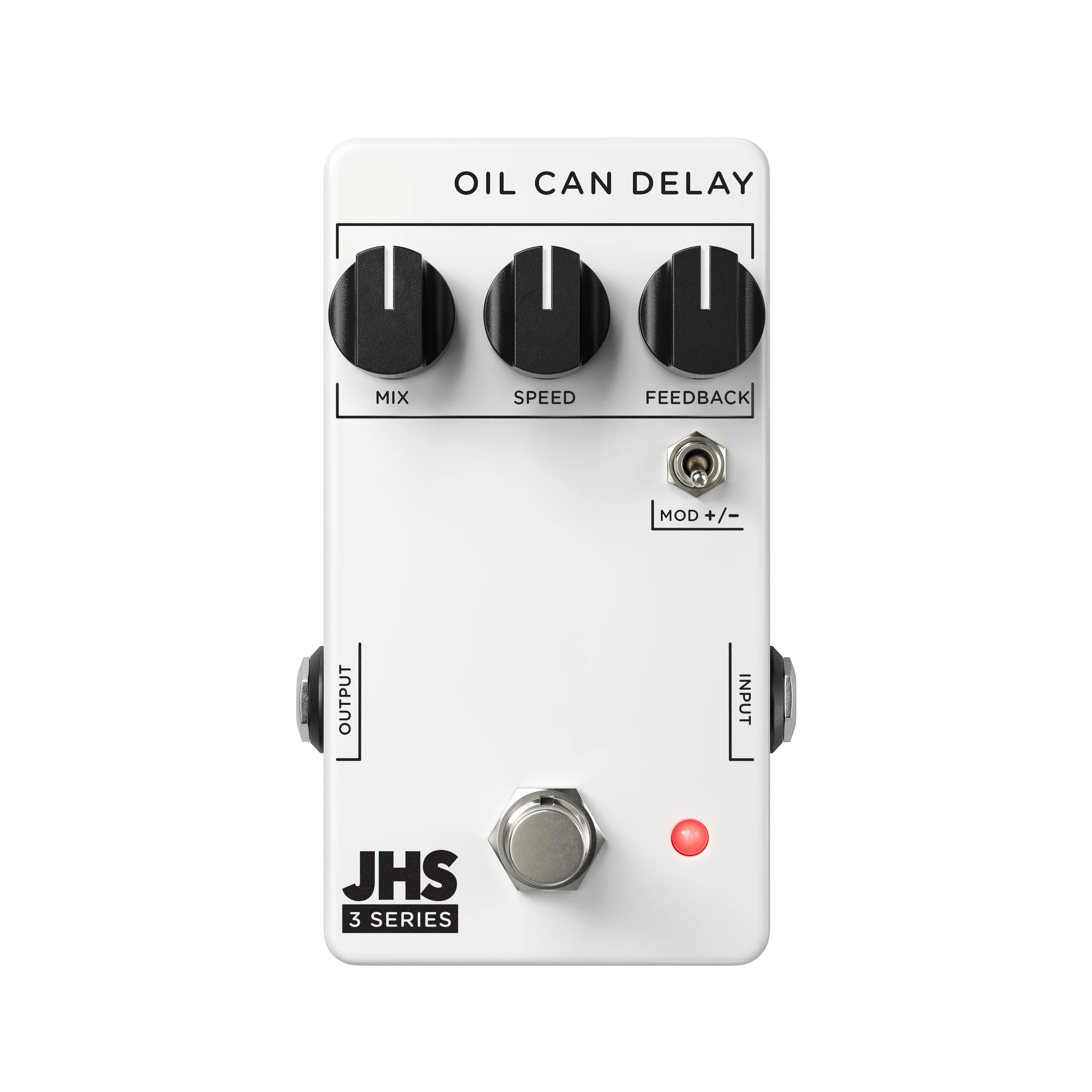
- Controls the mix of echo and clean signal. Left is less, right is more.
SPEED
- Controls the length of the delay time from 100ms to 330ms. Left is shorter, right is longer.
FEEDBACK
- Controls the amount of feedback or repeats of the delay signal. Left is less, right is more.
+/-
- The toggle allows you to switch between modulation intensities. In the down position, you have light movement, and in the up position, you have heavier movement. The modulation speed is associated with the delay time control (shorter is faster and longer is slower, reminiscent of the oil can warble in relation to the delay speed).
JACKS
INPUT
- 1/4” jack on the right side of the pedal.
OUTPUT
- 1/4” jack on the left side of the pedal.
THIS PEDAL REQUIRES STANDARD 9VDC NEGATIVE POWER, CONSUMES 65m, AND MEASURES 4.42” X 2.38” X 1.22”
Original: $145.00
-65%$145.00
$50.75More Images
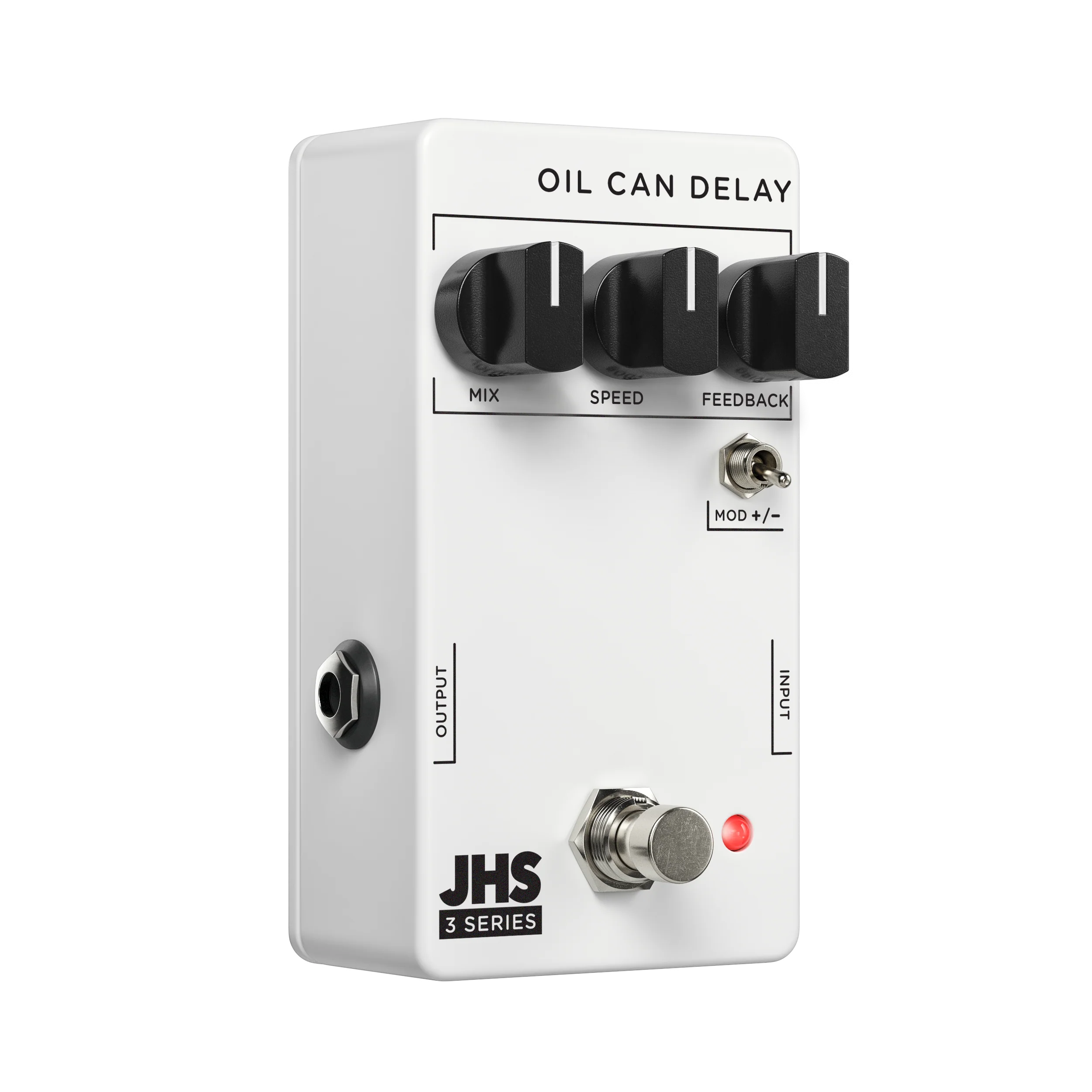
JHS Pedals - OIl Can Delay
The JHS Pedals 3 Series is a collection of pedals designed to give you affordability and simplicity without compromising quality. Each 3 Series pedal is made by us in Kansas City, MO, using high-quality parts, quality control, and attention to every detail. Each pedal has three simple controls and one toggle that offer a wide range of sounds, perfect for beginners and professionals alike. The JHS Pedals 3 Series will inspire your playing and help you explore new sounds at a totally approachable price point.
How We Got the Oil Can Delay
After being discharged from the army in 1946, Ray and Marv Lubow formed Tel-Ray Electronics, specializing in Television and Radio repair. As the company grew, Ray also began dabbling in audio inventions – specifically, delay. Les Paul had already pioneered an effect called tape echo, but folks were trying to figure out how to make a smaller, more practical version of this oversized effect. Inspired to do just that, on June 30, 1959, Ray submitted the patent for an electro-static delay apparatus known today as the oil can delay.
These delay units contained oil in a tuna-can shaped drum that was moved by a belt mechanism that turned the drum while a special disk apparatus on which the audio signal “charge” was written and read through rubber wiper “heads.” The playback speed was directly related to the drum’s rotation speed. The oil acted as a protective layer to keep the audio signal “charge” electrons in place, creating a truly unique echo effect with elements of vibrato and slapback delay. Ray Lubow began licensing the oil can delay technology to amplifier companies, including Fender, Gibson, and Rickenbacker. In the late 1960s, Ray and Marv decided they wanted to start selling their devices under their own brand name and launched the now legendary effects company, Morley. Ray chose the name as a none-to-subtle jab at their competitor Leslie: “Why settle for less with a Leslie when you can get more with Morley?” Morley manufactured oil can delays up until 1989.
Why Are We Making One?
At Wilco’s Solid Sound Festival in 2022, JHS founder Josh Scott found himself in a discussion with legendary guitarist Nels Cline. Nels brought up the subject of weird delays, leading to an in-depth discussion of the strangest pedals they’d ever played. Josh received a message from Nels a few days later asking if JHS made an oil can style delay and began explaining the particular sound he wanted from this type of echo. Though JHS didn’t have one in the official lineup, Josh and team developed a one-off oil can delay pedal. When they presented it to Nels as a gift, he liked it so much that he used it through the recording and touring process for Wilco’s Cruel Country and now their latest release, Cousin.
Though the JHS Oil Can Delay isn’t a signature artist pedal, we’re still grateful to Nels Cline for inspiring it. We’re proud to offer you this unique pedal for your own collection.
CONTROLS
MIX
- Controls the mix of echo and clean signal. Left is less, right is more.
SPEED
- Controls the length of the delay time from 100ms to 330ms. Left is shorter, right is longer.
FEEDBACK
- Controls the amount of feedback or repeats of the delay signal. Left is less, right is more.
+/-
- The toggle allows you to switch between modulation intensities. In the down position, you have light movement, and in the up position, you have heavier movement. The modulation speed is associated with the delay time control (shorter is faster and longer is slower, reminiscent of the oil can warble in relation to the delay speed).
JACKS
INPUT
- 1/4” jack on the right side of the pedal.
OUTPUT
- 1/4” jack on the left side of the pedal.
THIS PEDAL REQUIRES STANDARD 9VDC NEGATIVE POWER, CONSUMES 65m, AND MEASURES 4.42” X 2.38” X 1.22”
Product Information
Product Information
Shipping & Returns
Shipping & Returns
Description
The JHS Pedals 3 Series is a collection of pedals designed to give you affordability and simplicity without compromising quality. Each 3 Series pedal is made by us in Kansas City, MO, using high-quality parts, quality control, and attention to every detail. Each pedal has three simple controls and one toggle that offer a wide range of sounds, perfect for beginners and professionals alike. The JHS Pedals 3 Series will inspire your playing and help you explore new sounds at a totally approachable price point.
How We Got the Oil Can Delay
After being discharged from the army in 1946, Ray and Marv Lubow formed Tel-Ray Electronics, specializing in Television and Radio repair. As the company grew, Ray also began dabbling in audio inventions – specifically, delay. Les Paul had already pioneered an effect called tape echo, but folks were trying to figure out how to make a smaller, more practical version of this oversized effect. Inspired to do just that, on June 30, 1959, Ray submitted the patent for an electro-static delay apparatus known today as the oil can delay.
These delay units contained oil in a tuna-can shaped drum that was moved by a belt mechanism that turned the drum while a special disk apparatus on which the audio signal “charge” was written and read through rubber wiper “heads.” The playback speed was directly related to the drum’s rotation speed. The oil acted as a protective layer to keep the audio signal “charge” electrons in place, creating a truly unique echo effect with elements of vibrato and slapback delay. Ray Lubow began licensing the oil can delay technology to amplifier companies, including Fender, Gibson, and Rickenbacker. In the late 1960s, Ray and Marv decided they wanted to start selling their devices under their own brand name and launched the now legendary effects company, Morley. Ray chose the name as a none-to-subtle jab at their competitor Leslie: “Why settle for less with a Leslie when you can get more with Morley?” Morley manufactured oil can delays up until 1989.
Why Are We Making One?
At Wilco’s Solid Sound Festival in 2022, JHS founder Josh Scott found himself in a discussion with legendary guitarist Nels Cline. Nels brought up the subject of weird delays, leading to an in-depth discussion of the strangest pedals they’d ever played. Josh received a message from Nels a few days later asking if JHS made an oil can style delay and began explaining the particular sound he wanted from this type of echo. Though JHS didn’t have one in the official lineup, Josh and team developed a one-off oil can delay pedal. When they presented it to Nels as a gift, he liked it so much that he used it through the recording and touring process for Wilco’s Cruel Country and now their latest release, Cousin.
Though the JHS Oil Can Delay isn’t a signature artist pedal, we’re still grateful to Nels Cline for inspiring it. We’re proud to offer you this unique pedal for your own collection.
CONTROLS
MIX
- Controls the mix of echo and clean signal. Left is less, right is more.
SPEED
- Controls the length of the delay time from 100ms to 330ms. Left is shorter, right is longer.
FEEDBACK
- Controls the amount of feedback or repeats of the delay signal. Left is less, right is more.
+/-
- The toggle allows you to switch between modulation intensities. In the down position, you have light movement, and in the up position, you have heavier movement. The modulation speed is associated with the delay time control (shorter is faster and longer is slower, reminiscent of the oil can warble in relation to the delay speed).
JACKS
INPUT
- 1/4” jack on the right side of the pedal.
OUTPUT
- 1/4” jack on the left side of the pedal.
THIS PEDAL REQUIRES STANDARD 9VDC NEGATIVE POWER, CONSUMES 65m, AND MEASURES 4.42” X 2.38” X 1.22”